Wednesday, June 06, 2012

Tree Sketches


Original Post: 05/23/2007 

Here is a tree study. I'm working on dramatic light and shadows....


Here is another tree study. This one I am working on getting the feel of the tree.  You can see the pencil strokes are following the cylindrical form of the trunk to capture the three-demension of the trunk.


These sketches are concentrating on the light playing on the leaves and branches of the tree.


Tree knots, growths and deformities add character and interest to trees.  Here is a study of such features:

Sketch Kit

A Sketch Kit
Original Post Date :07/07/07

I understand the importance of drawing every day. And there are many times I get stuck on a concept that I want to write down and find I don't have paper with me. I have tried many different varieties and flavors of sketch books; large, small, thick, thin. I haven't seemed to find the right combination of a portable writing; sketching book that let's me play.

I finally broke down and purchased my first moleskin journal. http://www.moleskines.com/klmbl13.html I purchased the large sketchbook style 5.25x8.25.

The size is wonderful and the paper is thick.

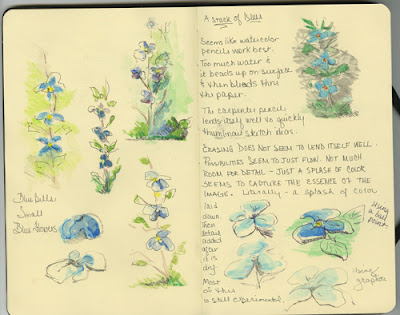
Here are just a couple of pages from my journal. Most of what I've been doing is experimental yet - but I've been more successful than in any previous attempt. Is it the size? Is it the paper? Is it the medium? Or the combination of the three?

New materials are always fun and can lead to great experimentation and creativity. Here are the materials that I currently have in my little black carry bag:
I stumbled upon a new technical pen by Staedtler that uses a permanent ink and flows very smoothly. Much better than the Kohinoor pens I have been trying. http://www.artstuff.net/staedtler_technical_pens.htm

Watercolor pencils seem to work much better than watercolor paints. I use Primacolor Watercolor pencils with a Niji Water Brush. It is a pen barrel that holds water. Perfect for travel and just enough water on the brush to bring the colors out.

 
A carpenter pencil. The big flat pencils that carpenter's use. It is great to do fast sketches with. http://www.victorystore.com/business/pencils/carpenter.htm

A .7mm mechanical pencil with HB lead. I can't be without a mechanical pencil!


Perspective with Multiple Buildings

Using perspective with a common horizon line allows the two barns to sit together on the same plane.  They will look like they belong together in the scene. 

There will only be one horizon line (eye level). All the buildings will meet at the same 2 convergence "X's" on the horizon line.

The green line is the horizon line. The red lines are for the foreground building. The blue lines are for the building in the background.

Sketching

When I'm not working on a 'full-sized' drawing, I am sketching.    Sketching provides the opportunity to
  •  explore your subject matter and medium
  •  exercise and stretch your skills
  •  test out new techniques
  •  explore textures, compositions, lighting effects
Sometimes sketches are indeciferable to any one but the artist, nothing more than scribbles.  Other times, they can become a finished artwork.  But most of the time, sketches are just snippets of thoughts or an impression of an idea. 
For an artist, sketching is the most uninhibited and free-est expressive moment possible.  Sketching is an artform in itself and give the viewer insight into the soul of the artist.
 

Two-point Perspective

Step one. Identify the three main vertical lines of the building. I use a t-square ruler to make sure my lines are straight. The line in the center will be the longest. You can also use your pencil to "site" the length and positioning of the vertical lines. 


Step two: The green line through the center is considered the horizon line. This is also your eye level view of the scene.

When you connect the vertical lines, the green line should be in the center of the angled lines. The angled lines will eventually converge in a "X" through the green line. This convergence is usually off the paper as in this example.

As you view the image below, you can see that the windows, door and roof line all follow the same lines. 


Perspective is a principle of design technique that creates depth and realism to a scene.  It gives the illusion of three demension on a two demension surface, the paper.

Wednesday, May 30, 2012

Recent Article


Here is a recent article posted on Pencils.com about.....me.


Two weeks ago, we reintroduced our Pencils.com featured teaching artist Mike Theuer and the first of his many tips for artists. Today, Studio 602 is excited to reintroduce Diane Wright and her tips for making the most out of your graphite.

“It has been almost two years since I was first introduced to the Blackwing. In reviewing all the attributes I thought hindered drawing with wooden pencils, I’ve discovered that they are actually positive characteristics. The relationship between my hand, pencil and paper evolves into an unified artistic expression. There is no medium that is as simple or direct as the graphite pencil. There is no doubt that the wooden pencil creates a much more expressive line than using a mechanical pencil. Harnessing and controlling that line can breath life to your drawing.

Here are a couple of tips that I’d like offer.

- Holding your pencil in an underhand position creates a much more fluid line. Using the handwriting grip tends to restrict the pencil and creates a tight mark.

- The shape of the pencil tip makes a big difference on how frequently you have to sharpen and the variety of line created. A chisel point, with one side flat creates a broad stroke and the edge can be used for detail.

- Explore creating a variety of pencil marks to represent different textures. Choosing to use a dull pencil point can offer subtle differences and organic nuisances as well.

I recently have been using a variation of the chisel point. As I draw, I rotate my pencil to create three flat sides that taper to a point. Using the underhand grip, holding the pencil at an angle, and rotating the pencil, I can use the pencil without sharpening until it is almost to the wood. This maximizes the use of the graphite as well as extending the time between sharpenings.

This small sketch was created using these techniques. The Blackwing is perfect to create bold marks and apply the graphite quickly, allowing your ideas to come alive on the paper.”

- Diane Wright

Saturday, April 28, 2012

The Blackwing Experience


Charles Berolzheimer invited me to the NYC Blackwing experience. While I had to gracefully decline to attend, I thought "What a cool idea and fun event."

Today, I am retiring my very first Blackwing that I was introduced to almost two years ago. As my pencil is now too short to use anymore, I started to think about my own Blackwing experience.

Looking back at all attributes I thought hindered the use of wooden pencils, over time they now have culminated into positive characteristics. The relationship between the pencil, paper and myself subtly evolves through the artistic expression. Sharpening a wooden pencil is almost a ritual. Using the pencil as it dulls enhances the drawing, offering subtle differences and organic nuisances. Then at a particular point, I stop. Sharpen. And start the process again. It seems to breathe life into the drawing. As the pencil gets smaller, I use a pencil extender to extend its life. Until finally the affair of collaboration ends and the drawing is completed.

Can a simple pencil make such a difference? I think so. I love my Blackwings and Palominos.